← USER INTERFACE

Can Gamification & Emotional Design Help Beginners Stay Consistent?

View Full Case Study Here

View Full Project Here
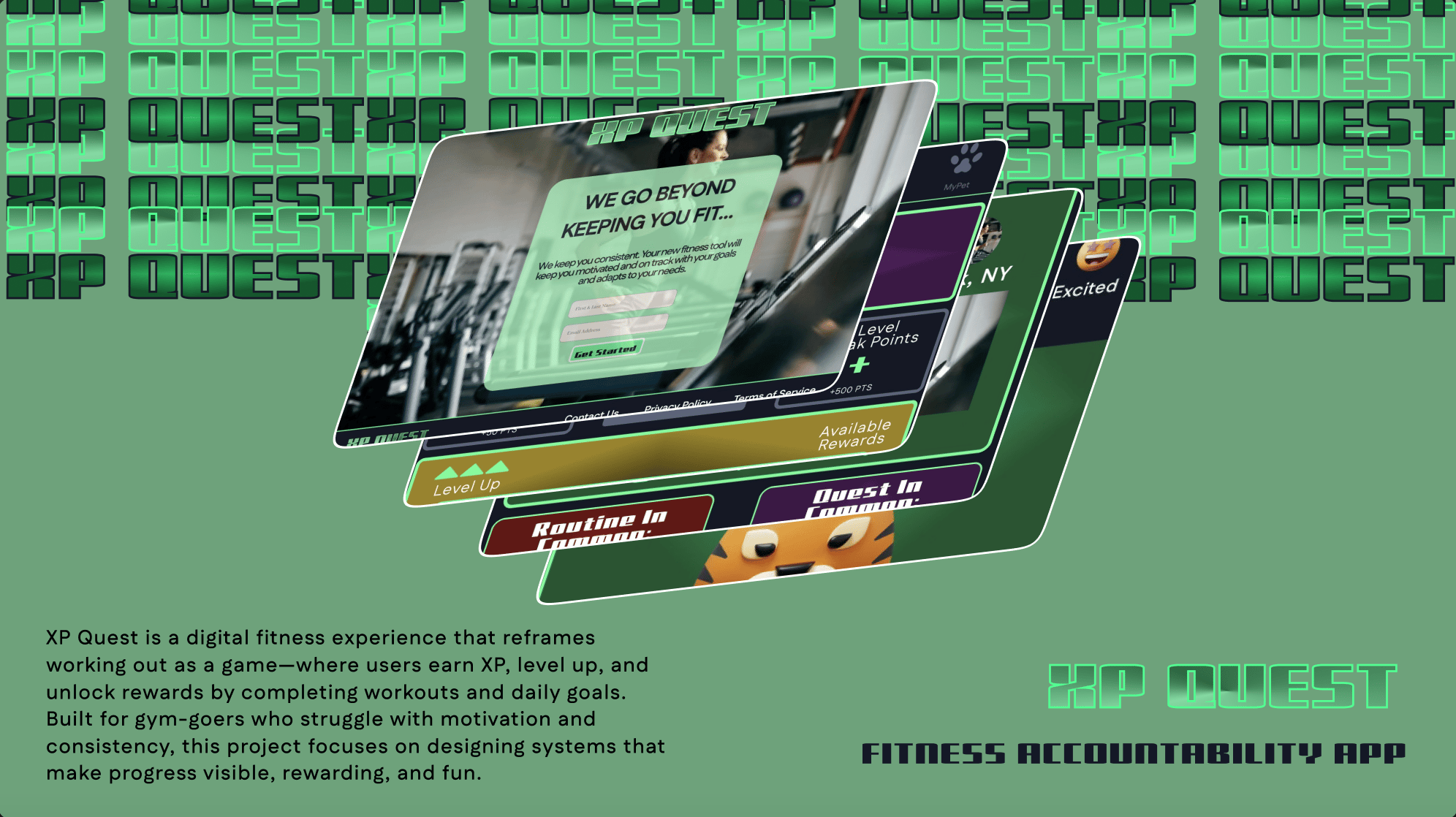
xp quest cover

Project Overview

​

XP Quest is a gamified fitness experience designed to help beginners build consistency through goals, progress tracking, rewards, and playful interactions.

​

Role: UX /UI Designer

Project: Fitness app concept

Methods: User personas, journey mapping, user flows

Deliverables: Wireframes, dashboard, reward system, interactive features

The First Problem

Many gym-goers don’t struggle with wanting to work out — they struggle with staying consistent once motivation fades. This lack of clear progression and reward made fitness feel disconnected from effort. Without visible wins or a sense of achievement, users lost momentum — not because they were lazy, but because the experience failed to keep them engaged over time. Solving this problem mattered because consistency, not intensity, is what leads to real fitness progress — and the product experience wasn’t supporting that behavior.

“When I can see progress in levels or points, I actually want to keep going. It feels less like working out and more like completing something — like I’m winning at it.”— Chris Patel

The Solution

To address this, I designed a centralized rewards page that turns effort into visible, immediate wins. Instead of hiding progress behind charts or logs, XP Quest surfaces rewards upfront through points, streaks, levels, and redeemable challenges.Every action — completing workouts, maintaining streaks, hitting hydration goals — earns points that contribute to leveling up. This reframed fitness from an abstract long-term goal into a series of achievable milestones, reinforcing consistency through positive feedback. By making progress tangible and rewarding, the experience shifts from “Did I do enough?” to “I’m clearly advancing.”

The Second Problem

While rewards helped users understand progress, research revealed another emotional gap: personal accountability.Several users shared that when fitness was only “for themselves,” it was easier to skip a day without consequence. Progress bars alone weren’t enough to overcome moments of low motivation.This created a drop-off point where users knew what to do but lacked an emotional reason to show up consistently — especially on harder days.

“I’m way more consistent when something depends on me. If it’s just for myself, I’ll skip a day — but if there’s a streak, a character, or even something virtual I’m responsible for, I don’t want to let it down.”— Lena Rodriguez

The Solution

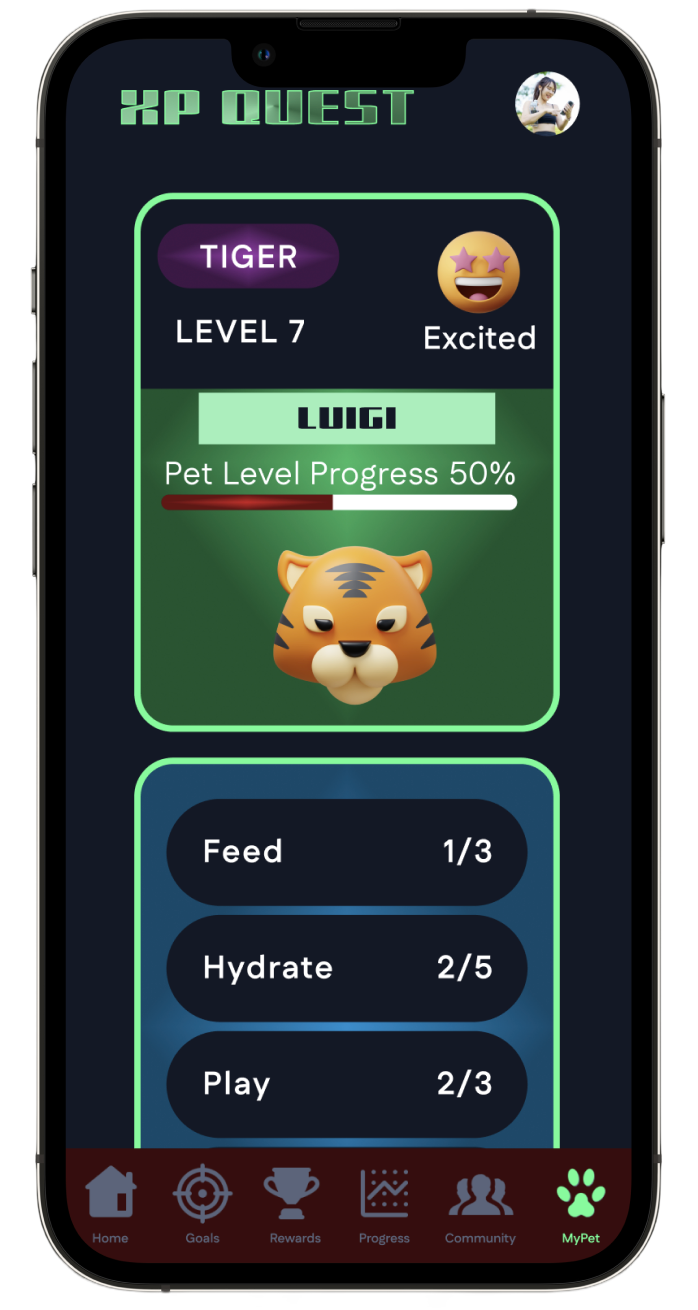
The MyPet feature was designed to add emotional weight to daily actions.Instead of progress being solely numeric, users care for a virtual pet that grows, levels up, and responds to their consistency.Completing workouts, hydrating, and maintaining streaks directly impacts the pet’s progress. Missing goals doesn’t punish the user — but it creates a sense of responsibility that motivates action. This transformed fitness from a solo task into a relationship users emotionally invested in to increase long-term engagement.
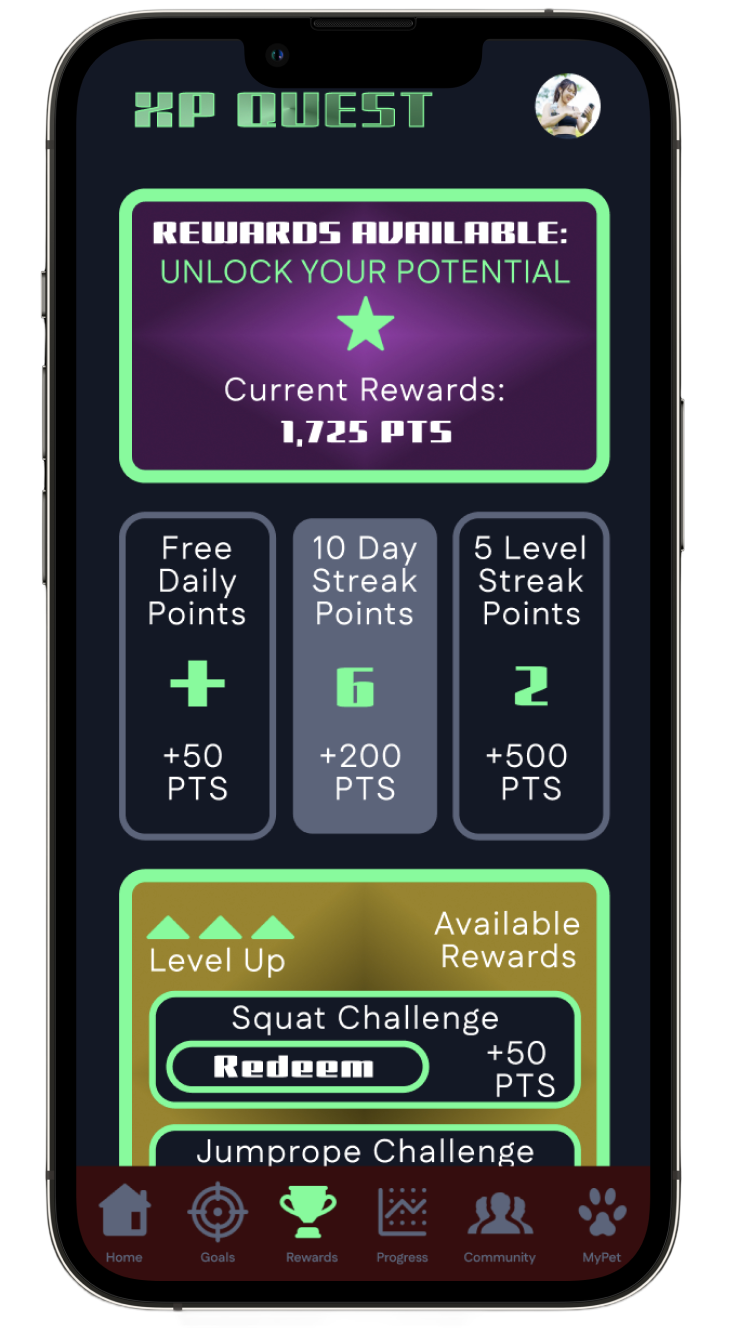
xp quest rewards screen
xp quest my pet feature phone screeen

The Process

  • The user persona grounded the project in a real beginner’s mindset—someone motivated but easily overwhelmed—so design decisions stayed focused on confidence, clarity, and consistency rather than advanced performance.
  • Mapping the journey exposed emotional drop-off points, especially after onboarding, where motivation dipped and habits broke—highlighting where encouragement and structure were most needed.
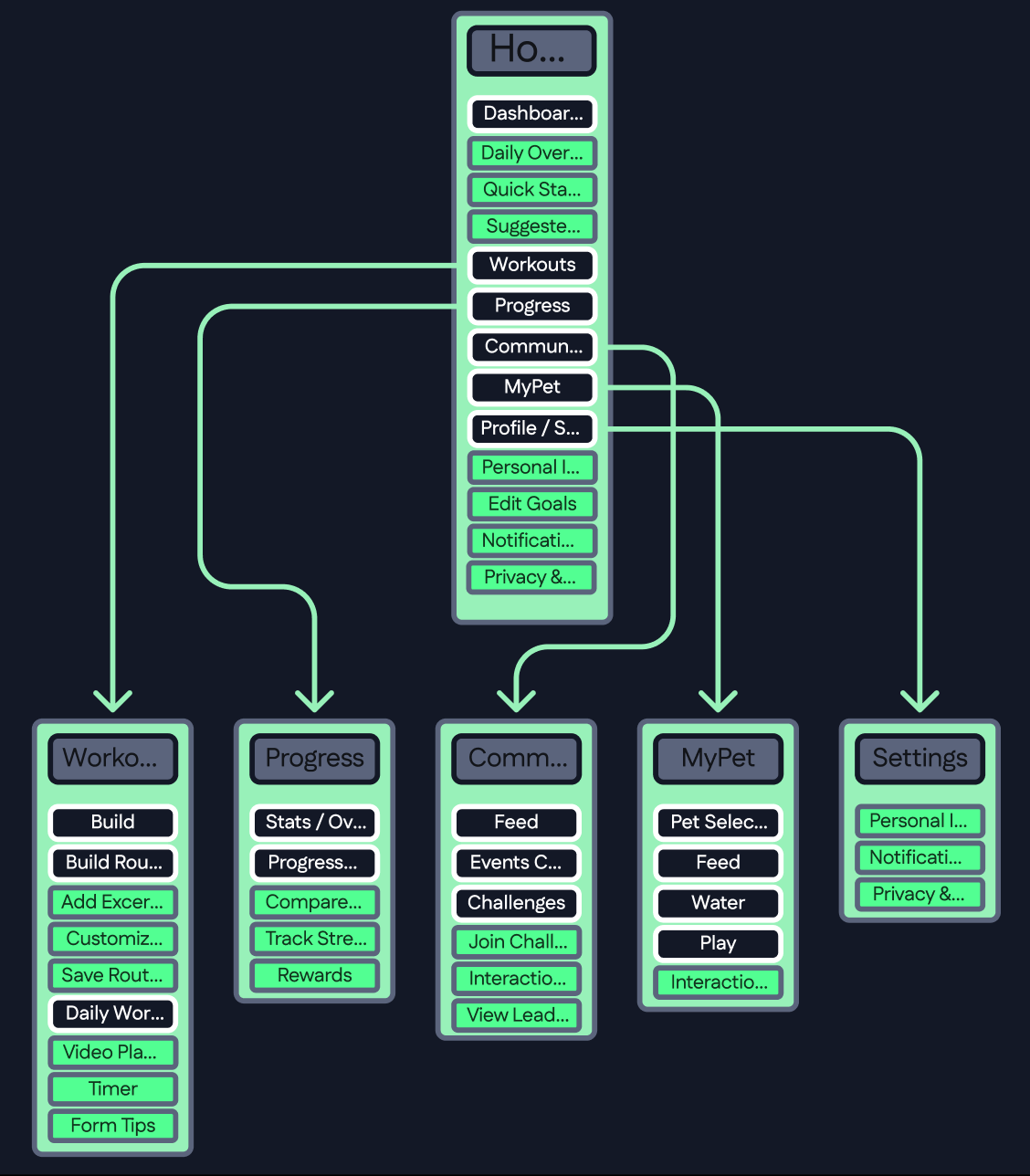
  • The product map helped translate user needs into a clear feature hierarchy, ensuring core experiences like workouts, progress, and MyPet were easy to access without overload.
  • Low-fidelity wireframes allowed me to quickly test layout, navigation, and feature prioritization before investing in visuals, revealing early friction around progress tracking and rewards.
  • The high-fidelity prototype brought the experience to life, validating that visual feedback, gamification, and the MyPet feature made the app feel motivating rather than intimidating.

Reflection

At the start, I assumed beginners mainly needed simpler workouts. But research and early usability testing showed something deeper: people weren’t quitting because workouts were hard—they were quitting because they felt alone, unsure if they were “doing it right,” and unmotivated when progress felt invisible.That insight shifted my focus. Instead of just refining workout flows, I leaned into emotional reinforcement. The MyPet feature emerged as a way to externalize progress—turning consistency into something users could see and care for. Rewards were refined to feel earned but not overwhelming, reinforcing effort rather than perfection.As the design evolved, I constantly checked decisions against one question: Does this make starting—and coming back—feel easier? That lens guided everything from simplified navigation to gamified streaks and visual progress indicators. Each iteration reduced friction and increased moments of encouragement, transforming the app from a tracker into a supportive companion.This project taught me that motivation is just as much a design problem as usability. The biggest impact came from shifting away from feature-heavy solutions toward emotional clarity and habit reinforcement.If I had more time, I’d expand usability testing around long-term retention and explore deeper personalization within MyPet. Looking back, the contrast between early concepts and the final experience reinforces an important lesson: good design isn’t about adding more—it’s about listening better, adapting faster, and designing for how people actually feel.

Chantàl Baez

← USER INTERFACE

Can Gamification & Emotional Design Help Beginners Stay Consistent?

View Full Case Study Here

View Full Project Here

xp quest cover
An illustrative sketch of a flower

Project Overview

​

XP Quest is a gamified fitness experience designed to help beginners build consistency through goals, progress tracking, rewards, and playful interactions.

​

Role: UX /UI Designer

Project: Fitness app concept

Methods: User personas, journey mapping, user flows

Deliverables: Wireframes, dashboard, reward system, interactive features

The First Problem

Many gym-goers don’t struggle with wanting to work out — they struggle with staying consistent once motivation fades. This lack of clear progression and reward made fitness feel disconnected from effort. Without visible wins or a sense of achievement, users lost momentum — not because they were lazy, but because the experience failed to keep them engaged over time. Solving this problem mattered because consistency, not intensity, is what leads to real fitness progress — and the product experience wasn’t supporting that behavior.

“When I can see progress in levels or points, I actually want to keep going. It feels less like working out and more like completing something — like I’m winning at it.”— Chris Patel

The Solution

To address this, I designed a centralized rewards page that turns effort into visible, immediate wins. Instead of hiding progress behind charts or logs, XP Quest surfaces rewards upfront through points, streaks, levels, and redeemable challenges.Every action — completing workouts, maintaining streaks, hitting hydration goals — earns points that contribute to leveling up. This reframed fitness from an abstract long-term goal into a series of achievable milestones, reinforcing consistency through positive feedback. By making progress tangible and rewarding, the experience shifts from “Did I do enough?” to “I’m clearly advancing.”

The Second Problem

While rewards helped users understand progress, research revealed another emotional gap: personal accountability.Several users shared that when fitness was only “for themselves,” it was easier to skip a day without consequence. Progress bars alone weren’t enough to overcome moments of low motivation.This created a drop-off point where users knew what to do but lacked an emotional reason to show up consistently — especially on harder days.

“I’m way more consistent when something depends on me. If it’s just for myself, I’ll skip a day — but if there’s a streak, a character, or even something virtual I’m responsible for, I don’t want to let it down.”— Lena Rodriguez

The Solution

The MyPet feature was designed to add emotional weight to daily actions.Instead of progress being solely numeric, users care for a virtual pet that grows, levels up, and responds to their consistency.Completing workouts, hydrating, and maintaining streaks directly impacts the pet’s progress. Missing goals doesn’t punish the user — but it creates a sense of responsibility that motivates action. This transformed fitness from a solo task into a relationship users emotionally invested in to increase long-term engagement.
xp quest phone screen

The Process

  • The user persona grounded the project in a real beginner’s mindset—someone motivated but easily overwhelmed—so design decisions stayed focused on confidence, clarity, and consistency rather than advanced performance.
  • Mapping the journey exposed emotional drop-off points, especially after onboarding, where motivation dipped and habits broke—highlighting where encouragement and structure were most needed.
  • The product map helped translate user needs into a clear feature hierarchy, ensuring core experiences like workouts, progress, and MyPet were easy to access without overload.
  • Low-fidelity wireframes allowed me to quickly test layout, navigation, and feature prioritization before investing in visuals, revealing early friction around progress tracking and rewards.
  • The high-fidelity prototype brought the experience to life, validating that visual feedback, gamification, and the MyPet feature made the app feel motivating rather than intimidating.

Reflection

At the start, I assumed beginners mainly needed simpler workouts. But research and early usability testing showed something deeper: people weren’t quitting because workouts were hard—they were quitting because they felt alone, unsure if they were “doing it right,” and unmotivated when progress felt invisible.That insight shifted my focus. Instead of just refining workout flows, I leaned into emotional reinforcement. The MyPet feature emerged as a way to externalize progress—turning consistency into something users could see and care for. Rewards were refined to feel earned but not overwhelming, reinforcing effort rather than perfection.As the design evolved, I constantly checked decisions against one question: Does this make starting—and coming back—feel easier? That lens guided everything from simplified navigation to gamified streaks and visual progress indicators. Each iteration reduced friction and increased moments of encouragement, transforming the app from a tracker into a supportive companion.This project taught me that motivation is just as much a design problem as usability. The biggest impact came from shifting away from feature-heavy solutions toward emotional clarity and habit reinforcement.If I had more time, I’d expand usability testing around long-term retention and explore deeper personalization within MyPet. Looking back, the contrast between early concepts and the final experience reinforces an important lesson: good design isn’t about adding more—it’s about listening better, adapting faster, and designing for how people actually feel.