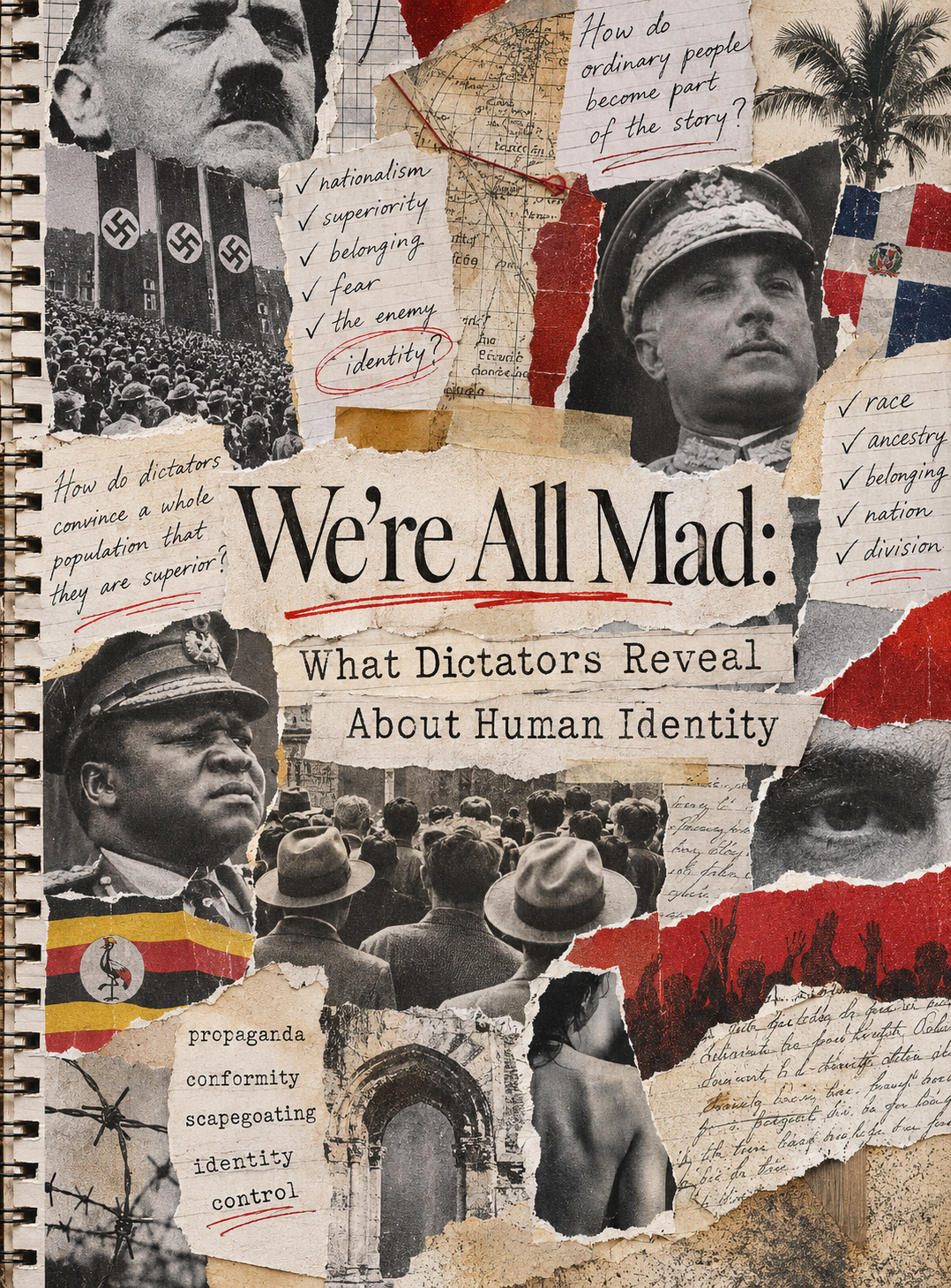
We’re All Mad:
What Dictators Reveal About Human Identity

Article | ~ 12 min read
Imagine being told that you are superior to someone else simply because you were born.
No accomplishments necessary. No intelligence required. You don't even have to be a decent human being. Just exist.
Somehow, millions of people were convinced that this was a perfectly reasonable way to organize humanity.
I used to think Adolf Hitler was a genius.
Not because I admired the man or his ideology, but because, even in middle school, I couldn't understand how someone could sell such an absurd idea to so many people. My fascination began during a 5th grade class trip to Washington, D.C., when I visited the United States Holocaust Memorial Museum. I learned about the Holocaust and the man whose regime orchestrated the systematic murder of six million Jews, along with the persecution and murder of millions of others.
Because it was the first massacre I had ever heard of, all I remember thinking coming out of there was, ‘how’?
What fascinated me was the manipulation. The ability to convince millions that they belonged to a superior race while everyone else was somehow beneath them. I thought Hitler understood something about people that the rest of us either couldn't see or didn't want to admit.
Here was a man with dark hair, dark eyes, and an appearance that hardly resembled the blond-haired, blue-eyed figures celebrated in Nazi propaganda. Yet he stood before crowds preaching racial superiority with enough conviction that millions accepted the hierarchy he promoted.
Of course, Nazi racial ideology was more complicated than hair and eye color. Its classifications revolved around ancestry, supposedly pure bloodlines, and a collection of pseudoscientific theories that had absolutely no business being called science. The Nazis didn't require every German they classified as Aryan to resemble their propaganda posters.
They were constructing a racial hierarchy, not holding a beauty pageant. Still, the contradiction fascinated me.
How does someone convince people of an ideal he doesn't visually represent? More importantly, why do so many people accept the idea that their existence is inherently more valuable than someone else's?
For years, I assumed the answer was simple.
People are sheep.
A little dumb, perhaps.
But the older I get, the less satisfying that explanation becomes.
I started to understand that people aren't necessarily incapable of thinking critically. Sometimes they're perfectly capable of questioning what they're told. They simply choose not to.
Maybe questioning would make them uncomfortable. Maybe it would cost them their place within a group. Or maybe it's easier to believe something when everyone around you already believes it.
And I think that distinction is far more frightening.
The Privilege of Being Superior
Hitler did not invent antisemitism, racism, or the desire to belong to something greater than oneself. He inherited a society already struggling with political instability, economic hardship, resentment, and the consequences of World War I. He took existing prejudices and transformed them into an ideology that promised national restoration through racial hierarchy.
The Nazi concept of Volksgemeinschaft, or people's community, offered Germans a collective identity supposedly rooted in shared blood, ancestry, and national destiny.
Belonging came with privileges. Exclusion came with consequences.
Jews, Roma and Sinti, Black people, people with disabilities, political opponents, and others designated undesirable were subjected to different forms of discrimination, persecution, and violence. Under Nazi rule, racial ideology became embedded in law, education, employment, citizenship, and eventually systematic mass murder.
The Holocaust was not merely the result of people believing ridiculous things about race. It was the result of a regime turning those beliefs into policies, institutions, and organized killing.
But there's something psychologically interesting about the promise Hitler offered those who were considered part of his ideal community. You didn't necessarily have to accomplish anything extraordinary to feel extraordinary. You simply had to belong.
Imagine being told that your ancestry alone made you more intelligent, more civilized, more deserving, and more important than another human being. No personal achievement required. Your superiority was apparently included with your birth certificate.
What a convenient arrangement.
In 1971, psychologist Henri Tajfel and his colleagues published experiments examining how people behaved when divided into groups based on relatively meaningless distinctions. Even without a history of hostility or meaningful competition, participants sometimes favored members of their own group when distributing rewards. Some even preferred maximizing the difference between groups rather than maximizing the total benefit. People could favor their own group when the distinction separating them from everyone else barely meant anything. Now imagine those divisions reinforced by schools, newspapers, political speeches, laws, and a government that rewards you for belonging.
Tajfel and psychologist John Turner later developed social identity theory, which explores how membership in groups contributes to our understanding of ourselves. The theory doesn't explain the Holocaust on its own. A laboratory experiment cannot account for the political machinery, antisemitic history, coercion, and deliberate decisions that made genocide possible. But it does help explain why group identity can become so emotionally important. Once people begin to associate their self-worth with the superiority of their group, equality can start to feel like a threat.
If your identity depends on being better than someone else, what happens when that person demands to be treated as your equal?
Perhaps the most dangerous thing about racial superiority is that it gives people something they believe they can lose. Not their humanity, but their position above someone else’s. Of course, not everyone living under Hitler supported his ideology. Some actively participated in persecution, others benefited from it, remained indifferent, complied out of fear, or resisted.
That difference matters.
The circumstances surrounding a person influence their decisions without making every decision inevitable. Even within a society built around obedience, people were still capable of choosing differently. Which makes me wonder whether the problem is always our inability to recognize what's wrong, or our willingness to accept it when being right comes at a personal cost.
When The Enemy Looks Like You
I am half Dominican.
Growing up, I knew who Rafael Leónidas Trujillo was, or at least I recognized his name. What I didn't understand until college was that he had ruled the Dominican Republic as a dictator. For years afterward, I avoided looking too deeply into what he had done. Maybe part of me didn't want to know.
It wasn't until a conversation with my father after college that I began to understand the scale of his brutality, particularly the 1937 massacre of Haitians and Dominicans of Haitian descent. What I remember about that conversation wasn't necessarily what my father said, but how he said it. With indifference. He spoke about the massacre almost as though he were explaining any other historical event. And at the time, I didn't think much of his reaction.
It wasn't until years later, after learning more about Dominican history, that I began to reconsider that conversation. My father is dark-skinned. He had told me about a dictator whose government promoted racial distinctions that devalued blackness, and he'd delivered the information as though it were simply another piece of history.
I don't know what his reaction meant. Perhaps he'd heard about the massacre enough times that discussing it no longer carried the same emotional weight. Perhaps he simply viewed it as a historical event. But I eventually found myself questioning something much larger than his response.
It changed how I viewed Dominicans as a whole.
Globally, Dominicans are often associated with being fun, loving, welcoming people.
And we are.
But how do I reconcile that image with the prejudice that exists toward the people who share our island?
How can a culture celebrate warmth and hospitality while some of its members carry such hostility toward their neighbors?
Haiti and the Dominican Republic share the island of Hispaniola. Their histories are distinct, shaped by different colonial powers, political struggles, languages, and national identities. But both societies also carry the legacies of African enslavement, European colonialism, and centuries of racial classification.
Under Trujillo, anti-Haitian nationalism became a particularly violent instrument of political power.
In 1937, Dominican forces and collaborators massacred thousands of Haitians and people of Haitian descent in the border region. Historian Edward Paulino has estimated approximately 15,000 deaths, although historical estimates vary. These weren't all people who had recently crossed a border.
Historian Sabine Cadeau's research documents how the massacre targeted people whom the Dominican state itself recognized as citizens but rejected as ethnically and racially undesirable.
Imagine being a citizen of a country and still being told, through violence, that you don't belong there.
This wasn't simply an argument about immigration. It was state-sponsored racial and ethnic violence. Trujillo's regime promoted a national identity that emphasized Hispanic heritage and distance from Haiti, reinforcing an already existing history of anti-Haitian prejudice. And that's what makes the racial contradiction so interesting.
The Dominican Republic is a country shaped by African, European, and Indigenous histories. Yet Trujillo's government helped promote an image of Dominican identity that distanced the nation from Haiti and devalued aspects of its own African heritage.
A society could be encouraged to reject characteristics present within its own population. And some of those ideas became so ordinary that people hardly questioned them.
I think about the way skin color was described when I was growing up.
I was morena. My father, who is dark-skinned, was negro.
But lighter-skinned Dominicans? They were often just Dominican - no additional description necessary.
As a child, I didn't always think much of it. I've always loved my melanated skin. The words were part of the language surrounding me, and people often presented them as terms of affection. But as I got older, morena began to feel different. Sometimes it felt like an insult. Other times, what bothered me wasn't necessarily the word itself but the pattern behind it.
Why did my skin color require a label while someone else's didn’t?
Why was lighter skin so often treated as the unspoken standard?
I began to recognize something larger than the language itself - a hierarchy. One that could exist in everyday conversations without anyone stopping to question it. It turns out that the relationship between skin color, ancestry, and Dominican identity has been the subject of considerable academic research.
In Reconstructing Racial Identity and the African Past in the Dominican Republic, anthropologist Kimberly Eison Simmons examines how Dominican racial classifications developed through centuries of colonial history and government influence. She discusses the institutionalization of indio as a color category on Dominican identification documents, part of a broader history in which African ancestry was often pushed out of the country's official understanding of itself.
Think about the implications of that. A government can help establish the language people use to describe themselves. Over time, those descriptions become familiar. Eventually, people may forget that the categories they consider natural were shaped by political decisions.
But Dominican racial identity is more complicated than simply claiming that Dominicans refuse to acknowledge their African ancestry.
Research by Eva Michelle Wheeler challenges the tendency to portray Dominican racial classifications as uniformly confused or rooted in hatred of blackness. Dominican understandings of race vary across communities, generations, and social contexts.
That complexity matters.
The point isn't that every Dominican believes the same thing. It's that certain racial hierarchies can become so deeply embedded in a society that people encounter them in ordinary language without necessarily recognizing their history.
We take centuries of migration, colonialism, intermarriage, enslavement, and cultural exchange, then attempt to divide the resulting populations into neat categories of superiority and inferiority.
I don’t believe history or human beings were ever that tidy.
Historian Amelia Hintzen's research on the Haitian-Dominican borderlands offers another important complication. Her archival work documents how some local officials resisted Trujillo's earlier attempts to remove Haitians. She argues that the 1937 massacre also served to force obedience from local authorities and destroy relationships between Haitian and Dominican communities.
That challenges the idea that these communities were simply destined to hate one another. Relationships existed, people lived alongside one another and political power worked to redefine those relationships.
What I find particularly unsettling is what happens after the dictator is gone.
Trujillo was assassinated in 1961, yet the racial assumptions and national narratives reinforced during his rule didn't just disappear. Some survived through education, political rhetoric, family conversations, and the ways people continued to understand Dominican identity.
A dictator can die, but an ideology can outlive them.
Sometimes it survives so quietly that people no longer recognize it as an ideology. They call it culture, tradition or simply the way things have always been.
“Blaming a group of people is so much easier.”
The Convenience of Having Someone to Blame
In August 1972, Ugandan dictator Idi Amin announced the expulsion of Asians from Uganda, initially targeting those with British passports before the policy was broadened.
Many of these families had lived in Uganda for generations. They owned businesses, raised children, built communities, and understood the country as their home. But under Amin's government, their belonging became conditional. They were portrayed as outsiders, beneficiaries of economic inequality, and obstacles to the prosperity of other Ugandans.
People were given ninety days to leave. Tens of thousands were displaced, and Asian-owned businesses and property were confiscated. A person's home could suddenly become a place where they were no longer welcome. This wasn’t because the individual had committed a crime, but because a government had redefined who deserved to belong.
Uganda's economic and colonial history was complicated. Asian communities occupied different positions within its commercial life, and inequalities shaped relationships between groups. Amin transformed those tensions into a campaign against an entire population.
Scapegoating offers something psychologically convenient - an explanation.
If your country is struggling, if opportunities seem limited, if you feel overlooked or powerless, it can be comforting to believe someone else is responsible. Especially when that someone is easily identifiable.
Complex economic systems are difficult to understand. Political corruption is uncomfortable to confront. Historical inequality requires patience, knowledge, and the willingness to acknowledge contradictions. Blaming a group of people is much easier. When removing that group is presented as an act of national restoration, cruelty can begin to look like patriotism. Imagine living in a country your entire life, only to be told that you never truly belonged there.
What exactly makes someone a citizen of a country? Their birthplace? Their ancestry? Their language? Their contribution to society? Or the willingness of everyone else to accept them?
We like to believe identity is something personal. Something that belongs to us. But history repeatedly demonstrates how easily governments can interfere with that understanding.
Dictators don't necessarily need to convince everyone to hate. Sometimes they only need to convince enough people that someone else is standing in their way.
We’re Not as Independent As We Think
I believe prejudice is something we all develop to some degree. Not because we're born understanding racial hierarchies or inherently believing one nationality is better than another, but because none of us grows up without influence.
We observe, we listen, we imitate. We absorb assumptions about people long before we have enough experience to question them. Our families, neighborhoods, schools, religious communities, and media environments all contribute to how we understand the world.
Consider a neighbor who assumes every Hispanic family in the neighborhood is undocumented. Then he gets to know one family, learns they're citizens, and realizes his assumption was wrong. His prejudice changes because reality challenges what he believed.
Now consider another neighbor who makes the same assumption but decides to call immigration authorities, hoping the family will be removed without knowing anything about their actual status.
Both began with an assumption. But the second person turned that assumption into an action that could have serious consequences for someone else's life. That difference matters.
Prejudice and racism aren't entirely separate categories. Racist beliefs can exist without someone acting on them, and discrimination can be built into institutions without requiring every individual involved to express personal hatred. But there is an important difference between recognizing an assumption and being willing to reconsider it versus becoming so attached to that assumption that you're prepared to harm someone rather than question yourself.
One leaves room for learning. The other can turn ignorance into a weapon.
Perhaps this is where critical thinking becomes less about intelligence and more about willingness. I don't believe people are necessarily losing the ability to think. I wonder whether we're losing the habits, patience, and environments that encourage us to think carefully. We have access to more information than previous generations could have imagined, yet we are still capable of choosing ignorance over being better informed. And I don't think the problem belongs entirely to social media. Education plays a role. So does our desire for immediate answers, our fear of being wrong, and the discomfort that comes with disagreeing with people we care about.
Thinking critically requires more than knowing how to find information. It requires being willing to discover that something you've believed for years might be wrong. And what happens when that belief isn't simply an opinion? What happens when it's part of your family, your religion, your culture, or your political identity?
Questioning the belief can begin to feel like questioning yourself.
So perhaps it's easier not to.
The Comfort of Being Told What to Think
We no longer need to gather in enormous public squares to hear someone tell us who we should dislike, distrust, or blame. We can do it from our phones before breakfast. I sometimes wonder whether having so much information at our fingertips has made us less patient with the process of understanding any of it. We want immediate answers, explanations and immediate villains. And preferably someone who can summarize an entire complicated issue in thirty seconds.
Social media makes it easy to encounter people who agree with us, although it also exposes us to disagreement, competing perspectives, and information we might otherwise never see.
The technology itself doesn't determine what we believe. But I wonder how often we use it to challenge our assumptions rather than confirm them.
We see it in conversations about immigration, politics, race, religion, gender, and even beauty. Someone makes a claim. Someone else repeats it. A few thousand people agree. Suddenly, popularity begins to resemble credibility. And questioning the claim can make you the problem.
In 1955, psychologist Solomon Asch published research on conformity and social pressure.
In his experiments, participants were asked to make simple visual judgments about the lengths of lines. When other people in the room deliberately gave incorrect answers, some participants went along with the group despite the evidence in front of them. They could see the lines. They knew what they were looking at. And still, social pressure sometimes influenced their answers.
The experiments were limited laboratory studies, not demonstrations that people will inevitably obey dictators. But they raise a question I find difficult to ignore.
How often do people agree with something simply because disagreeing would make them uncomfortable?
Psychologist Albert Bandura's research on moral disengagement offers another perspective. He examined how people can justify harmful behavior by minimizing its consequences, shifting responsibility, using language that makes cruelty seem acceptable, or convincing themselves that the people being harmed somehow deserve it. And that last part is particularly interesting because most people don't walk around believing they're terrible human beings.
They believe they're reasonable, moral, fair. Even when their actions suggest otherwise.
We are remarkably good at finding explanations for our own behavior. When someone else does something cruel, we question their character. When we do something questionable, we consider our circumstances. Funny how that works.
None of this means that today's online arguments are equivalent to the Holocaust, the 1937 massacre, or Amin's expulsion of Ugandan Asians. They aren’t. The scale, institutions, historical circumstances, and consequences are profoundly different.
But the psychological tendencies that allow people to favor their own group, excuse harmful behavior, or blame outsiders are not confined to history books. And perhaps that's why studying dictators can be so uncomfortable. They force us to consider what happens when familiar human tendencies are exploited by people with extraordinary power.
What History Reveals
About Us
We love asking people who they are.
Surveys ask about our values, political beliefs, prejudices, personalities, and moral priorities. Are you tolerant? Are you open-minded? Do you believe everyone deserves equal treatment?
Most of us have a reasonably flattering idea of how we'd like to answer. But what people believe about themselves and how they behave under pressure aren't always the same thing. A survey can reveal important information about attitudes, and carefully designed studies can uncover patterns that individuals may not recognize in themselves. But a questionnaire alone cannot tell us exactly how someone will behave when their livelihood, reputation, safety, or social belonging is threatened.
History gives us something different.
It shows us what people supported, tolerated, resisted, and participated in when their beliefs were tested. It also reminds us that people faced different degrees of freedom, danger, and responsibility.
Someone who actively organized persecution was not making the same choice as someone who remained silent because speaking would endanger their family. And neither was making the same choice as someone who risked their life to resist. Those distinctions matter because understanding human behavior should not mean excusing it.
Still, I wonder how many of us are as independent as we believe ourselves to be.
How many opinions do we defend because we've carefully examined them?
And how many do we defend because they've become part of who we think we are?
We’re All Mad
I used to think the most interesting thing about Hitler was his ability to convince millions of people that they were superior. Then I learned more about Trujillo and began questioning the racial assumptions I'd grown up around. And now I find myself wondering whether I've been asking the wrong question all along.
Maybe the mystery isn't how dictators convince people of their superiority. Maybe it's why the idea of superiority appeals to people in the first place.
We study dictators as though they belong to a different species of human being. As though the people who followed them were somehow less intelligent, less moral, or less capable of independent thought than we are. Maybe they were. Or maybe that's simply what we need to believe about ourselves. Because it's much easier to recognize manipulation when we're looking backward.
We know what happened. We know how it ended. We know which beliefs history has exposed as dangerous, and we have the luxury of believing we would have behaved differently. Perhaps we would have. Some people did. But I don't think we should be so quick to congratulate ourselves for choices we've never had to make.
Maybe we're not all mad in the same way. Maybe we're simply more willing to recognize irrationality in other people than in ourselves. And maybe the most dangerous thing about believing you're an independent thinker is assuming that being one requires no further effort.
If you believe you're too intelligent to be manipulated, how would you know if you already had been?
References & More Reading:
- Nazi racial ideology: United States Holocaust Memorial Museum — Nazi Racism
- Group identity: Tajfel et al. (1971), Social Categorization and Intergroup Behaviour
- Dominican racial identity: Kimberly Eison Simmons, Reconstructing Racial Identity and the African Past in the Dominican Republic
- Dominican color terminology: Eva Michelle Wheeler, research on Dominican racial identity
- The 1937 massacre: Sabine Cadeau, More than a Massacre
- Haitian-Dominican border communities: Amelia Hintzen, A Veil of Legality
- Conformity: Solomon Asch (1955), Opinions and Social Pressure
- Moral disengagement: Albert Bandura (1999), Moral Disengagement in the Perpetration of Inhumanities
- Ugandan Asian expulsion: UK National Archives — Ugandan Asians
